
0.005 BTC and the Power Bill: Timing a Small Rig's Output
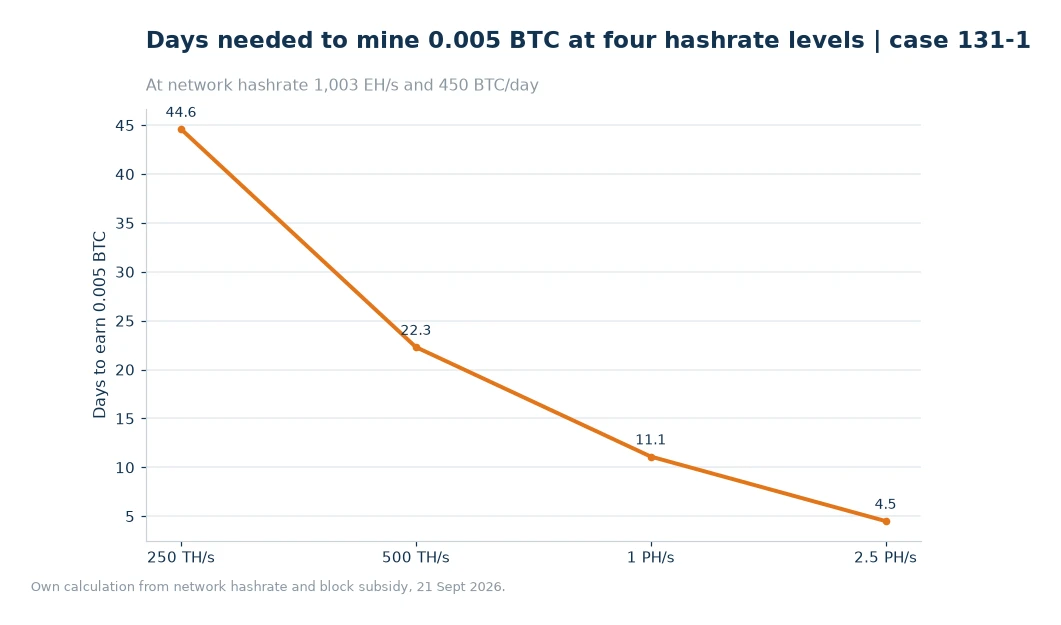
A power bill arrives on a date someone else chose. Coins arrive on a schedule set by difficulty and hashrate. Bringing the two into the same month is the whole job of a small mining budget, and 0.005 BTC is a convenient target for the exercise: at 250 TH/s it takes 44.6 days, at 1 PH/s it takes 11.1 days, and at today's price it is worth $423.46. Those three facts are enough to plan a payment cycle.
Key takeaways
- 0.005 BTC equals $423.46 at $84,692, a useful size for comparing against a monthly household cost.
- A 250 TH/s machine needs 44.6 days for that amount, so one calendar month covers roughly two thirds of it.
- Pool Hashrate and Pool Luck explain the pool's block rhythm but do not change a PPS+ miner's hourly credit.
- The gap between the bill date and the target date is a cash-flow question, not a mining question.
The bill arrives on a fixed day; the coins do not
Household costs are monthly by convention. Mining output is continuous, which sounds like an advantage until the bill lands and the coins are still short of the amount that would cover it. The mismatch is not a failure of the machine. It is a mismatch between two calendars, and it can be planned around once the daily output is written down.
Small miners often skip that step because the numbers are small in dollar terms. That is exactly when the calendar matters most. A shortfall of $40 on a $120 bill is a third of the obligation, and it is easier to see coming from a daily rate than from a monthly total that only exists in hindsight.
Picking a target that fits a billing cycle
0.005 BTC works as a target because it is small enough to complete inside a couple of months at modest hashrate and large enough to be visible against a bill. The useful comparison is not the target itself but the fraction of it produced in thirty days. If a month of running covers most of the target, the rig is roughly aligned with the cost it is meant to offset. If it covers a small slice, the bill and the machine are living on different scales.
The exercise also forces an honest decision about what the coins are for. If they are savings, the bill should be paid from income and the mining output left alone. If they are meant to offset power, then the target should be sized to the bill rather than chosen for roundness. Those are different plans, and mixing them produces the uncomfortable situation where every withdrawal feels like a setback.
Pool Hashrate, Pool Luck and the household ledger
Pool Hashrate is the pool's share of the network, and Pool Luck is how its recent block finds compare with expectation for that share. Both belong on a dashboard, and neither belongs in a monthly household budget, because a PPS+ miner is paid hourly against difficulty rather than against the pool's luck. The budget line should use the steady credit; the luck series is context for understanding why the pool's block list looks uneven.
The ViaBTC BTC Mining Pool page shows Pool Hashrate and Pool Luck side by side, and a household miner can read it in under a minute. The pool's share tells you how often blocks appear in its list; the luck figure tells you whether recent finds ran ahead of or behind expectation for that share. Neither number is an input to your monthly total, but both are useful context when one week's credit looks thinner than the last.
Where the two numbers do matter is in choosing a settlement scheme. A miner who wants the monthly figure to be predictable is better served by PPS+, which is the default, even though its listed 4% on the block-reward component is higher than the 2% listed on both components under PPLNS. A miner who can tolerate a lumpy month in exchange for a lower listed rate may prefer the other side. That is a temperament decision as much as an arithmetic one.
Four sizes against a thirty-day bill
The table keeps the target at 0.005 BTC and shows what each hashrate produces in a month, which is the number that meets a bill.
| Machine | Coins per day | Days to target | Coins per month | Monthly dollars |
|---|---|---|---|---|
| 250 TH/s | 0.00011215 | 44.6 | 0.0033645 | $284.93 |
| 500 TH/s | 0.00022430 | 22.3 | 0.0067290 | $569.85 |
| 1 PH/s | 0.00044861 | 11.1 | 0.0134583 | $1,139.71 |
| 2.5 PH/s | 0.00112153 | 4.5 | 0.0336459 | $2,849.16 |
When the target finishes before the bill
At 2.5 PH/s the target completes in 4.5 days, well before any monthly bill. That sounds like success and is really a planning problem in disguise, because the surplus accumulates in coins while the bill accumulates in currency. The two only meet when a withdrawal happens, and a withdrawal is a decision with its own timing, fee and confirmation delay. Leave it too long and the coins sit idle; move too early and the amount is too small to be worth the transfer.
The clean way to handle it is to fix a withdrawal date a few days before the bill is due and take whatever has accumulated by then. That turns the mining output into a monthly payment in practice, not just on paper, and it keeps the pending transaction clear of the due date. A machine large enough to overshoot the target comfortably is really a savings machine, and treating its output as bill cover understates what it is doing.
Worked example
Take the 250 TH/s case and check how much of a 0.005 BTC target a single billing month actually covers.
- Divide the daily issuance by the network: 450 ÷ 1,003,000,000 = 0.00000044865 BTC per TH/s, or 4.5e-07 in shorthand.
- At 250 TH/s: 250 × 0.00000044865 = 0.00011216 BTC a day.
- Thirty days: 30 × 0.00011216 = 0.0033648 BTC, or about 67% of 0.005.
- Full target: 0.005 ÷ 0.00011216 = 44.6 days, so it completes early in the second month.
- In dollars: 0.0033648 × 84,692 = $284.96 for the month, and 0.005 × 84,692 = $423.46 for the target.
- The shortfall against the target is 0.0016352 BTC, about $138.50, which is what the second month has to finish.
That is the whole budgeting method: one daily rate, one monthly multiple, one shortfall. It also shows why a second machine changes the picture more than a tariff negotiation usually does. Doubling hashrate halves the days to target and doubles the monthly coverage, while the power draw rises with it. The bill and the output move together, which is the point people miss when they look at only one side.
Frequently asked questions
Can 0.005 BTC cover a monthly power bill?
At $84,692 it is worth $423.46, so whether it covers a bill depends on the bill; a 250 TH/s machine produces about $284.96 in thirty days, while a 500 TH/s machine produces about $569.85 in the same period.
Why does a month not complete the target at 250 TH/s?
Because the target takes 44.6 days at that hashrate, so thirty days reaches roughly 67% of it; the remaining 0.0016352 BTC is completed early in the following month.
Do Pool Hashrate and Pool Luck change my monthly total?
Not under PPS+, which settles the block-reward component hourly against difficulty; luck only feeds through to payouts under PPLNS, where the pool distributes what it actually finds.
Put the daily rate next to the due date
Write the daily BTC figure on the same page as the bill's due date, then multiply by the days between payments. If the product is close to the bill's dollar value, the machine is sized sensibly for the job. If it is far above, the surplus is savings rather than bill cover, and it should be treated that way. The Statistics page supplies the network total for the division, and hosted options on the Mining Farms side are worth pricing if the household supply cannot carry a second machine.
Sources: ViaBTC pool-state, statistics, farms and fee pages for Pool Hashrate, Pool Luck and the listed 4%[1]. Taken on 21 Sept 2026: network at 1,003 EH/s, subsidy of 3.125 BTC per block, 144 blocks daily, BTC $84,692. First posted 24 October 2026; monthly coverage assumes constant difficulty and full uptime.