
Okoume Faces for Decorative Cabinetry and Wall Panels
Okoume stands out primarily for its face: a natural veneer in a warm pinkish-red tone with uniform grain, on a panel of relatively low density that stays dimensionally stable. Dongstar Wood lists okoume uses as marine, furniture, interior decoration, cabinetry and architectural designs, with compliance support through CE EN13986 and low-emission glues E1 and E0. The face is the specification; the rest of the panel exists to protect it.
Key takeaways
- The decorative specification starts with the surface: natural okoume veneer, warm pinkish red, with grain uniform enough to finish evenly.
- The density is relatively low compared with many hardwood plywoods, which aids handling and dimensional stability.
- Named uses are marine, furniture, interior decoration, cabinetry and architectural designs.
- Compliance support runs through CE EN13986 and low-emission glues E1 and E0.
The look: pale red to pinkish tone, uniform grain
The page describes the face in two parts: the colour, a pale red to pinkish tone, and the structure, a uniform grain. Together they are what a decorative buyer is actually specifying. The tone is warm and light, which is why okoume faces appear in cabinetry and wall panels where the wood is meant to be seen; the uniform grain is why the face takes finishes evenly, without the blotching that a wilder grain produces under stain.
The surface is described as smooth, calibrated and precision-pressed, with a tight thickness tolerance. Those three words are the panel's promise to the face: the veneer is cut to a consistent thickness, pressed flat, and held to a tolerance that keeps the surface even across the sheet. A decorative panel is only as good as the surface under the finish, and the finish is only as good as the face.
Why the density matters for decorative work
The page notes a relatively low density compared with many hardwood plywoods, and frames it as an advantage rather than a limitation. A lower-density panel is easier to handle on site and in the workshop: it cuts cleanly, it lifts without strain, and it fixes without the fight that a dense hardwood panel gives a screw. For wall panels and cabinetry, where the panel is handled many times before it is finally fixed, that ease of handling is a real cost saving.
The same density supports dimensional stability, which is the property a decorative buyer actually cares about. A wall panel that moves with the seasons opens gaps at the joints and shows the building's movement on its face. The page's combination of calibrated veneers, precision pressing and tight thickness tolerance is the manufacturer's answer to that movement, and it is the reason the panel can be specified for decorative work rather than hidden inside a carcass.
Marine and light-construction uses
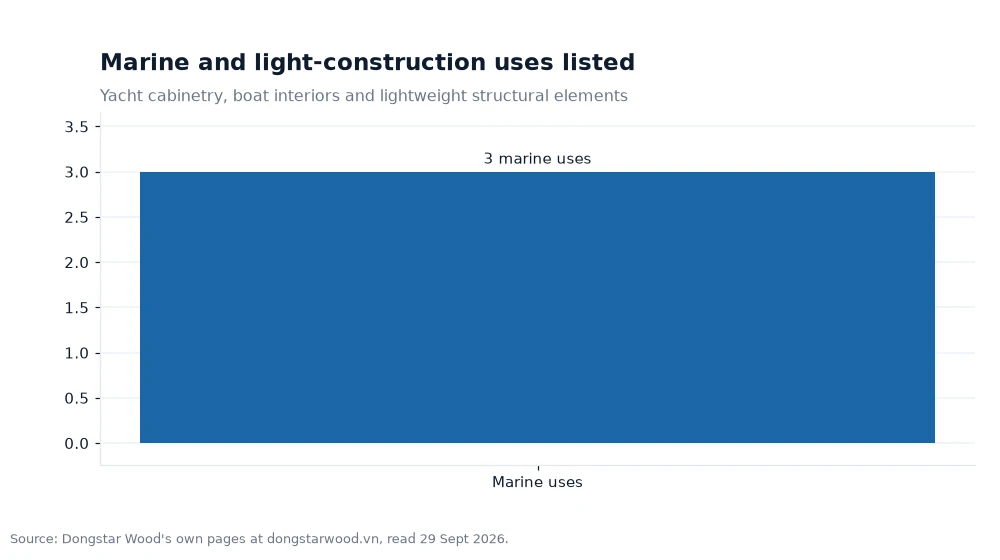
The named uses run from furniture — chairs, tables, cabinets, wardrobes — through interior panelling — wall cladding, ceiling panels, partitions — to joinery and architectural elements such as doors, trims and decorative accents. The marine and light-construction group is listed separately: yacht cabinetry, boat interiors and lightweight structural elements. The common thread is weight: every one of these uses is a place where a heavy panel would be a problem and a stable, light one is a solution.
The page states that the okoume timber is sourced from sustainably harvested forests, and that the species is native to Africa. For a decorative buyer, the sustainability note is part of the specification rather than a marketing extra: a panel that is specified for a visible surface in a public building has to answer the question of where its face came from, and the answer has to be documented rather than asserted.
Finishing: paints, stains, laminates and clear sealers
The page lists what the face accepts: paints, stains, laminates and clear sealers. That list is the practical definition of a decorative surface. A clear sealer shows the pale red tone and the uniform grain exactly as they are; a stain shifts the tone while keeping the grain visible; a paint covers the wood entirely and uses the panel for its stability rather than its appearance; a laminate adds a wear layer for the positions that get touched.
The finishing choice is a specification decision because it determines the face grade and the tolerance the panel has to hold. A clear finish on a visible surface wants the most uniform face the mill can supply; a painted surface is more forgiving. An Okoume Plywood Supplier that publishes its finishing options gives the buyer the list to write the finish into; one that does not leaves the finish to be discovered after delivery.
Compliance: CE EN13986 and low-emission glues
The page states that many manufacturers support CE EN13986 compliance, which is the construction product standard that governs wood-based panels placed on the European market. For okoume panels used in architectural elements — doors, trims, decorative accents — the CE documentation is the bridge between the panel and the building, and it is the document that turns a decorative material into a compliant one.
The glue options are E1 and E0, the low-emission classes that matter when the panel ends up in an occupied interior. A yacht cabin, a hotel wall and a kitchen cabinet are all small, enclosed spaces where the air is breathed for hours, and the emission class is the specification that keeps those spaces safe. The compliance story of an okoume panel is therefore two documents: the CE file for the construction side, and the emission certificate for the interior side.
| Input | Published position | What it protects |
|---|---|---|
| Face | Pale red to pinkish, uniform grain | The decorative appearance the panel is chosen for |
| Density | Relatively low for a hardwood plywood | Handling on site and dimensional stability |
| Surface | Calibrated, precision-pressed, tight tolerance | An even base for paint, stain, laminate or sealer |
| Compliance | CE EN13986, E1 and E0 glues | Construction placement and interior air quality |
| Sourcing | Sustainably harvested timber, species native to Africa | The documented origin of the face |
Worked example: wall coverage per sheet
Example: a 1250 × 2500 mm sheet measures 1.25 m × 2.5 m = 3.125 m². A wall run of twelve panels therefore covers 12 × 3.125 = 37.5 m² of cladding, and a feature wall of 60 m² needs about 60 ÷ 3.125 = 19.2, so roughly twenty sheets with the joints planned.
Example: the same sheet area checks the ceiling. A ceiling of 24 m² needs 24 ÷ 3.125 = 7.68, so eight sheets, and the offcuts from the wall run are too small to reuse in a visible ceiling joint. Both are planning estimates on published sizes, each labelled as an example, and they reveal why the sheet size and the finish have to be fixed before the order is placed.
Frequently asked questions
What does an okoume face look like?
Okoume veneer appears on the product page with a warm pinkish-red tone and uniform grain structure. The light, even surface is what makes it popular for decorative cabinetry and wall panels.
Why is okoume chosen for marine interiors?
The page notes a relatively low density compared with many hardwood plywoods, which makes panels easier to handle while keeping dimensional stability. Marine interiors and light construction such as yacht cabinetry and boat interiors are the named uses.
Which compliance options come with okoume panels?
The page states that many manufacturers support CE EN13986 compliance and names low-emission glues E1 and E0. Ask for the documentation that matches the market the panels will be sold into.
From the face to a finishing schedule
An okoume order is, in effect, a finishing schedule wrapped in a packing list. The birch plywood product page shows the paler alternative for the same decorative positions, and the company's own profile lays out the factory and the accreditation set behind both. With the face, the density, the finish and the compliance documents fixed, the panels that arrive are the ones the finishing schedule was written for.
The measurements discussed were obtained from the company's published web pages reviewed on 29 September 2026[1].